Saturday, 1 January 2011

New Years Eve - Day Trip

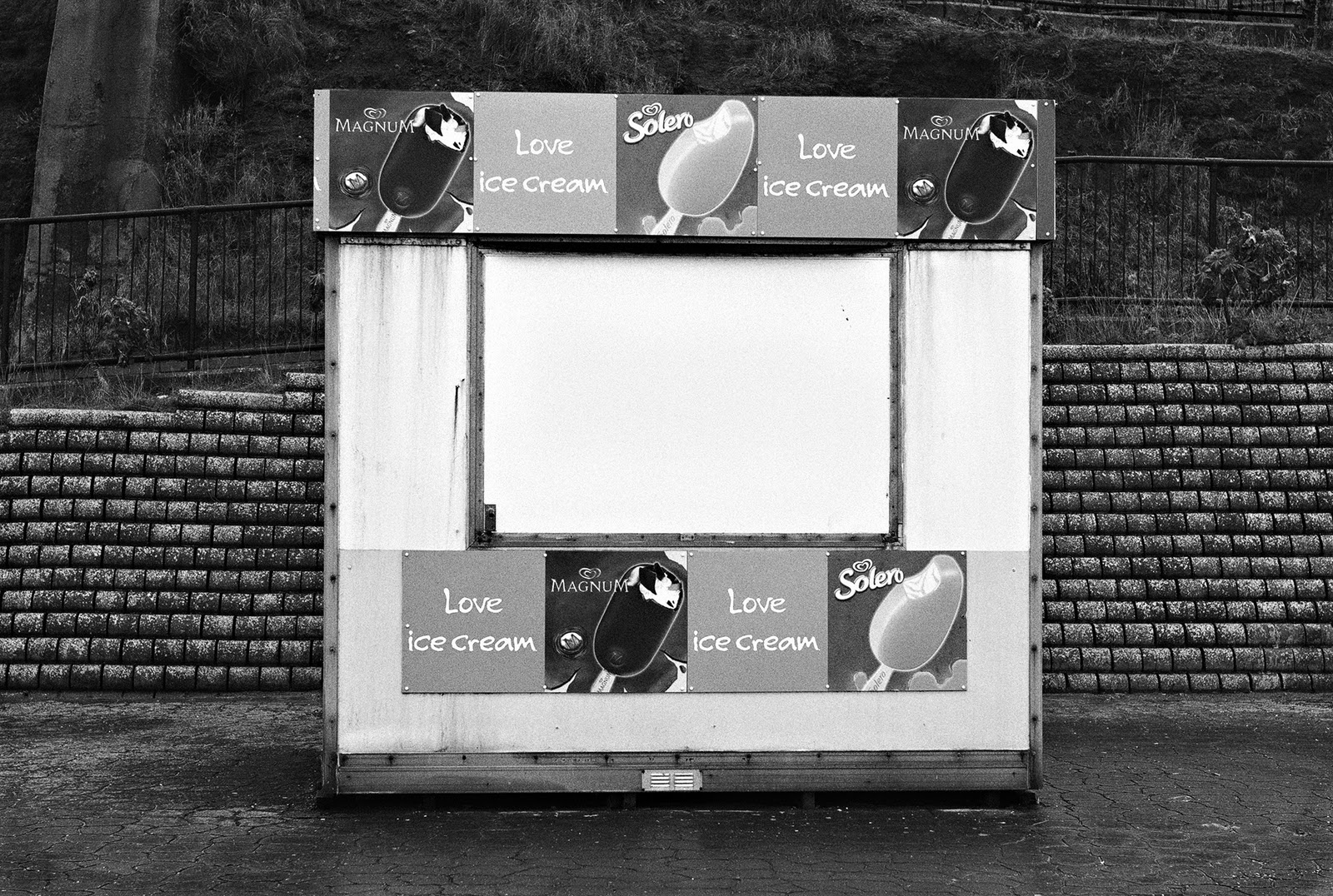
Undeterred by the near Nil visibility my friend Richard and his son Edward joined me for a day trip along the coast from Hunstanton to Cley for photography and food. We all had new toys from Christmas and were on our way to Hunstanton by 0800. Hunstanton in the winter is a dark and melancholic place, that would challenge anyone with a camera. The summer visitors enjoy a typical buckets and spades environment in the only east coast resort that has a sunset out at sea due to its west facing coastline within The Wash. The only buckets were with a few bait diggers looking for lug worm and seeing them in the vast empty space of the foreshore at low tide made me wonder why I hadn't packed any telephoto lenses. Anyway, the plan was to use the digital range finder and the 5x4 and move towards a minimalist style that had a naturalistic feel rather than the compressed perspective of telephoto and conversely the difficult world of wide angle The light was surprisingly good provided you didn't mind 640 ISO, 1/125 sec and f2, but on the other hand it was an even flat light that in a studio would be so hard to achieve. After an hour or so it was clear we had "done" Hunstanton and we needed coffee and buns. Hunstanton of course refused as it was shut and we moved further East. Further "closed" signs until we decided to give the RSPB a chance of doing some life saving at Titchwell where we found good beans on toast, bacon and coffee, with the enticing 50% off sign on the shop door to get us in and buying. Quite naturally the 50% off wasn't applying to the Leica spotting scopes so we moved on to Brancaster Staithe. Very foggy to the extent of being wet but I did manage a few (3) with the 5x4 using Delta 100. Typically the exposures were 1 sec at f22. The fog was closing in and became virtual rain so we pressed on to Wells next the Sea and to the "East End" where the cockle fisherman have their shed and boats. I didn't "get it" there. I looked at the ground glass on the Wista for a while and apart from showing a walker how a 5x4 camera worked didn't make any photographs. Moving further east we did various drive throughs at potential shooting places but with falling light headed for the beach at Cley. There isn't much there apart from shingle sea defence and about four small boats. The boats have space around them that almost puts them out of context, with no other features or fittings for fishing and I am sure there is good photography there, but not on this occasion. Last stop was for more food at the Norfolk Wildlife Trust visitor centre for more tea and cakes. 1430 now and almost dark.

So, 80 or so images with the M8 and 3 with the 5x4 and no real prospect of more than a few that I can use for coursework projects. But, none of that matters in reality. The issues here are that the more you shoot the more you learn, not only about simple matters of exposure and the like but a build up of ideas for the future. Subconsciously this small trip, which is similar to many from the past will provide me with a preamble when I next go to those locations. Even if none of that is true and photographically it was poor I now know that the RSPB at Titchwell do good beans and bacon, which cant be a bad thing to know.


Hunstanton - Closed

Leica M8 50mm Summilux 1/125 sec f1.4 ISO 640


Tuesday, 21 December 2010

Birding - Project 15 - 5x4

21st December, the shortest day of the year so probably not the best day to do some bird shots with the 600mm lens. Started the day with a "Winter" set for project 15. I now have all the seasons shot at Castle Acre and will process them and put them in the journal when I have caught up on some of other projects prior to 15. Also made some very wintery shots with the Wista 5x4 around Castle Acre, using Provia and Delta 100. Then to Cley and Salthouse for some bird shots. I have always wanted to do more with the 600mm lens and while the odd trip to Thetford forest for Dear never quite comes up with that magic moment and "Wildlife Photographer of the Year" I decided to have a look at seabirds and waders again. One reason for choosing them over songbirds in the garden is their size. The 600mm has a closest focus distance that is still 5m or so (cant remember exactly) and makes a finch small in the frame and a gull therefore is easier to fill the frame. Salthouse on the North Norfolk coast is about as cold and windswept a place that you will find. Problem number one was that the pools behind the shingle banks were 98% frozen over and not much prospect of gulls or waders using them. Some birds, havent looked up the names yet and a few images for todays posting, maybe more over Chritmas.


Nikon D3 600mm f4  1/1250 sec f5  ISO 1000


 Nikon D3 600mm f4  1/1250 sec  f5 ISO 1000


Nikon D3 600mm f4  1/800 sec F4 ISO 1000


And some departing Geese


Nikon D3 600mm f4  1/1000 sec f4 ISO 400


Wednesday, 15 December 2010

Harry Cory Wright

A recent thread on the OCA student site discussed various landscape photographers and their relevance to contemporary photography and how we as students of photography should be influenced (or otherwise) by the current well known names and names from the past. The discussion ranged from Ansel Adams through to modern protagonists such as Charlie Waite and Joe Cornish.

Much of the "National Trust" type, coffee table publications have gorgeous photography and they sell well in shops all around the land. A whole industry has grown up alongside this which teach you "how to" do the same and many enjoy that.

I have, like most others I guess had a go at this type of work and while there is some short term excitement at another 20 sec shot at f16 of a stream or sea with groynes, they are for me imitations of work by others (who have mastered the style) and why go there, is it worthwhile. One could argue that if I take as many rocky outcrops and ferns as say Joe Cornish or Edward Weston then I will be a good photographer.

What is happening here if I am not careful is blatant plagiarism dressed up as becoming educated and instead of looking for my own style and images I might as well just look for the tripod holes in the mud, buy a few books with location details and join the queue to expose my Vevia at Padley Gorge or wherever.

However, in the same way that Weston was influenced by Stieglitz, Beethoven by Mozart and Constable by the Dutch landscape painters of the 17th century it is unreasonable not to think that we are all under the influence of others to some extent.

I am, and his name is Harry Cory Wright. His work is not "typical" of what I have mentioned above and has been described as "banal" by some. Minimalist images that are not forcing themselves upon the viewer I feel have the potential to be longer lasting and while less fashionable in the short term, may have more to offer a viewer over a longer period. I have known of his work for a few years and have visited his gallery, often feeling that I wanted to know more about this work and not daring to enquire, because at that time it seemed "unusual" and I thought that I needed to stick with the mainstream and behave.

I need to make a step change, stop looking over my shoulder wondering who is watching me and be ready for comments that are challenging rather than complementary.

HCW's work can be seen at http://www.harrycorywright.com/index.php
Monday, 13 December 2010

Anticipation v Images = Bad Score

Sometimes I wonder if the anticipation of results from my photography is becoming over optimistic. I recently spent a number of hours along the North Norfolk coast around Cley and Salthouse on a very bright day, albeit very cold and was convinced that there were plenty of good images on the card. Tonight I am looking at them and I cant say there is one that I find inspiring and worthy of inclusion anywhere. At the time I was excited and busy, moving around with all the hints and tips running through my brain, for good composition, dealing with the difficult light but using incident readings and all to no avail. Ive tried a number of rescue remedies, high contrast monochrome, panoramic crop, selenium tone, but they are all poor.

The only bad technique that day was a zoom lens. Technically its very good but in the main I don't like them , and I like to use a single prime lens. The discipline of thinking in one field of view is better for me. Next time, no zoom. Pick say 2 primes and work around it.

For a while I am going to return to the course projects and work on the tasks. Maybe that will focus me on a task rather than the current roaming. Also they need to be completed and some of them are better done during these short days.